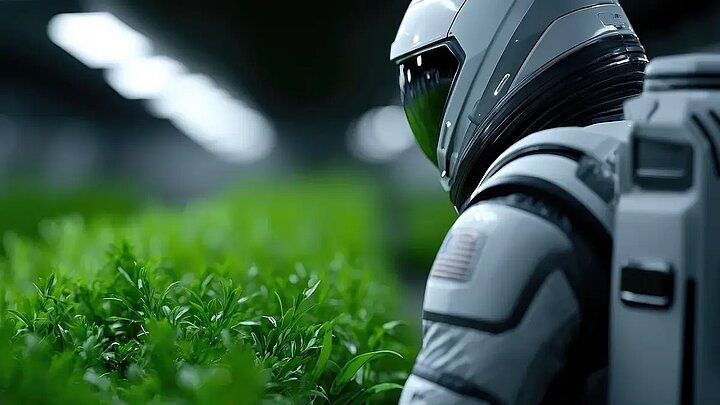
Can your own home become a space station? Is it possible to manage water, energy and food resources at home in a way similar to astronauts aboard the International Space Station?
The Faculty of Space Technologies is implementing the “Space at Home” project – an innovative research and educational initiative demonstrating that solutions developed for space exploration can have practical applications here on Earth.
The aim of the project is to investigate whether experiencing life “like on a space station” through a home-based simulation can influence everyday habits and pro-environmental attitudes. Participants will learn principles of managing limited resources similar to those applied during long-duration space missions.
The initiator and project leader of “Space at Home – Citizen Science as an innovative tool for shaping pro-environmental behaviours through the simulation of resource management on a space station” is Dr Marcin Zwierżdżyński, Head of the SpaceEduLab at the Faculty of Space Technologies.
The main objective of the project is to develop and test a research tool based on a mobile application that simulates resource management using the International Space Station (ISS) as a model.
Daily challenges faced by astronauts will be translated into simple tasks that can be performed at home. Participants will take on the role of “home astronauts” and make decisions related to:
The project applies the transfer of “space best practices” – solutions developed for the extreme conditions of space missions can inspire more sustainable and conscious resource management on Earth.
A specially designed mobile application will enable participants to take part in the simulation without the need for specialised equipment.
The project is carried out in the Citizen Science format, where participants actively contribute to the research process.
During the simulation, users will:
The collected data will allow the research team to assess the impact of the “living like on the ISS” experience on:
If the effectiveness of the proposed solution is confirmed, the application may become an educational tool used by schools, institutions and organisations interested in promoting sustainable behaviours.
Space at Home addresses challenges related to climate change, environmental degradation and the need for more responsible resource management.
The project is based on the idea that knowledge alone is not always sufficient to change established behaviours. Direct experience, active participation and the ability to observe the consequences of one’s own decisions can more effectively lead to long-term change.
The space-inspired simulation combines:
The implementation of the project requires combining knowledge from space technologies, social sciences and biology.
The main activities include:
The research team is supported by specialists from various fields:
Combining technological, environmental and social expertise enables the creation of a comprehensive research and educational tool.
The Faculty of Space Technologies at AGH University of Krakow is implementing the project together with:
The research results will be used to develop:
The project “Space at Home – Citizen Science as an innovative tool for shaping pro-environmental behaviours through the simulation of resource management on a space station” received funding of PLN 1,902,642.50 within the “Science for the Development of Society” programme of the Ministry of Science and Higher Education.
Find out more:

