News
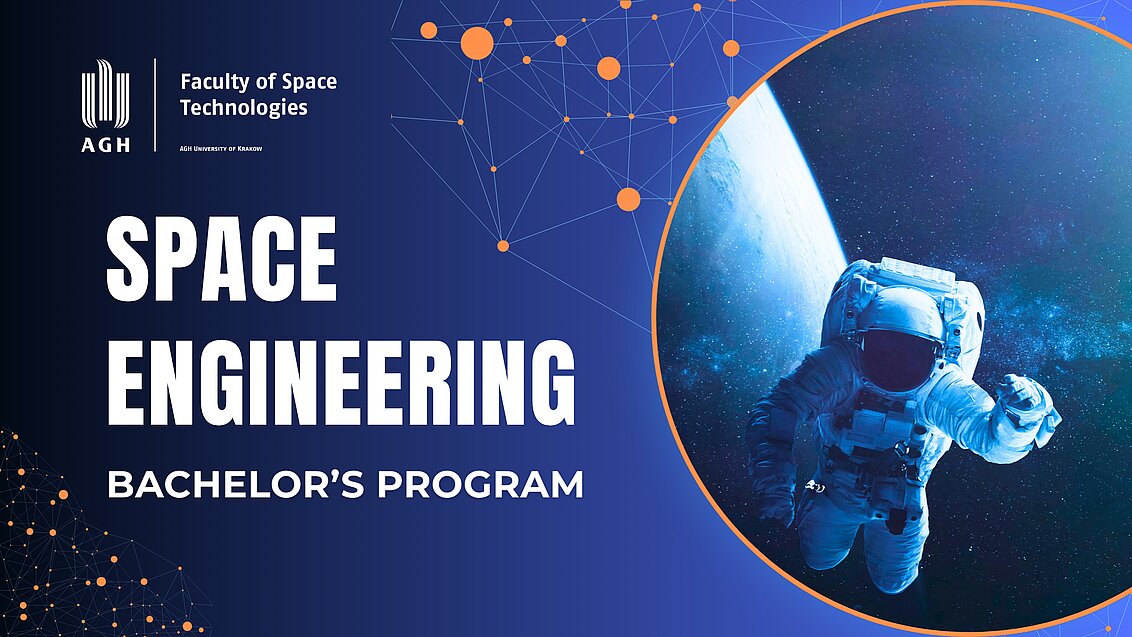
Do you have questions about the first-cycle Bachelor’s degree programme in Space Engineering? Below you will find some answers regarding the programme, admissions, and studies!
- How do I get admitted to Space Engineering?
Polish students: Admission is based on your high school final exam (matura) results.
International students: different admission procedures apply. A step-by-step guide to the recruitment process is available on the International Students Recruitment website: https://www.international.agh.edu.pl/en
- Are the courses taught in English?
Yes – all classes are conducted in English and taught by lecturers from Poland and abroad, including experts from the space sector, such as the European Space Agency.
The courses are delivered by practitioners who do not rely solely on theory but have designed technologies that have actually been sent into space.
From the very beginning, you study in an international environment that prepares you for a career in the space industry.
- Are the studies free of charge?
For Polish students, studies are free of charge.
For international students, tuition fees apply (details are available on the international admissions website): i https://www.international.agh.edu.pl/en
- I am an Olympiad participant. Does it guarantee admission?
Yes — this applies to selected Polish academic Olympiads.
A list of Olympiads that grant admission to Space Engineering studies is available on the AGH admissions website: https://rekrutacja.agh.edu.pl/kierunki-studiow/space-engineering/
- I have a vocational diploma / a diploma confirming professional qualifications in a technical field. Does it give me extra points?
Yes — this applies to selected Polish professional qualifications.
A list of all exams that provide additional points can be found on the AGH University admissions website: https://rekrutacja.agh.edu.pl/kierunki-studiow/space-engineering/
- Can Space Engineering be studied part-time?
No. At the moment, the programme is offered only as a full-time course of study.
- What will I study?
This programme is designed for people who want to work on real space-related projects, not just learn about them in theory.
At the beginning, you will gain solid engineering foundations, including mechanics, robotics, electronics, programming, and materials science.
Later, you will apply this knowledge to space technologies and real challenges in the space sector, such as:
- structures, materials, and propulsion systems for rockets and satellites
- satellite data analysis
- payload design
- avionics and flight dynamics
- ground infrastructure and communications
- mission design following sustainable space principles
These are areas actively used in the space industry.
- Do I choose a specialisation?
Not at the beginning. All students follow the same programme to build a strong foundation.
At Master’s level (Space Technologies), you can choose:
- Upstream (space technology design)
- Downstream (space mission data analysis)
- Biotechnology of Extreme Environments (new programme under development)
- What can I do after graduation?
A natural next step is continuing your education in the Master’s programme Space Technologies, where you can further develop competencies related to space technologies and gain specialised knowledge.
At the same time, Space Engineering opens up much broader opportunities. The knowledge and skills acquired can be applied not only in the space sector, but also in automation, robotics, aviation, and modern high-tech industry. It is a programme for people who want to design the technologies of the future — whether it is a satellite, an autonomous robot, or innovative solutions for industry.
- Is it easy to get a job after this programme?
Yes, and the number of opportunities is growing.
The space sector is developing rapidly – new companies, startups, and projects are emerging, and the demand for specialists in space technologies is increasing every year.
Additionally, during regular “Meet the Company” events you can:
- meet representatives of space and technology companies
- learn how companies operate
- network with industry professionals
- gain valuable contacts
- find internships or job opportunities
You will also complete an internship during your studies. Thanks to strong cooperation between the faculty and many companies in the space sector, gaining practical experience and starting your career becomes much easier.
- What international opportunities are available?
We are part of UNIVERSEH – a network of 7 European universities related to space science, including institutions from France, Germany, Poland, Sweden, Italy, Luxembourg, and Belgium.
This allows you to:
- take part in international courses and projects
- join short-term study programmes abroad
- meet international students and researchers
Additionally, you can take part in Erasmus+ exchanges, international conferences and competitions, as well as study visits to research centres and institutions such as ESA or ESTEC.
- What can I do outside of classes?
There are 10 student research clubs at the faculty focused on space-related topics – where you can learn almost as much as during lectures. Join one of them!
It is not only about projects and technical experience, but also:
- teamwork with people who share your passion
- national and international competitions
- trips for conferences, projects, and internships
- long-lasting professional and personal connections
- Why should i choose AGH University of Krakow?
AGH University of Krakow is one of the top technical universities in Poland. Studying here is not only about high-quality education but also about a unique student environment.
Kraków is one of the best student cities in Poland – dynamic, full of cultural events, opportunities, and academic life that makes studying more than just education.
The AGH campus is modern, well-organised, and designed so that everything is in one place, which makes daily student life convenient and efficient. The proximity of dormitories also supports integrationand helps build a strong student community.

