News
The Space Technology Centre AGH was established in November 2020 with the goal of uniting the academic community around research in space technologies. Now, after four years of dynamic development, the Centre is moving to a new, larger building, with an official opening set for October 4th, right after the inauguration of the 2024/2025 academic year.
The new space will allow for the establishment of additional laboratories, where scientists will be able to conduct even more intensive and effective research in space technologies. This will enhance the Centre's capabilities to develop innovative projects and strengthen its position as a leader in the field.
'We are currently in the process of equipping laboratories where STC staff will conduct research. Students involved in space science clubs will also have workspaces in the new building to develop their projects,' says Prof. Tadeusz Uhl, Director of the Space Technology Centre AGH .
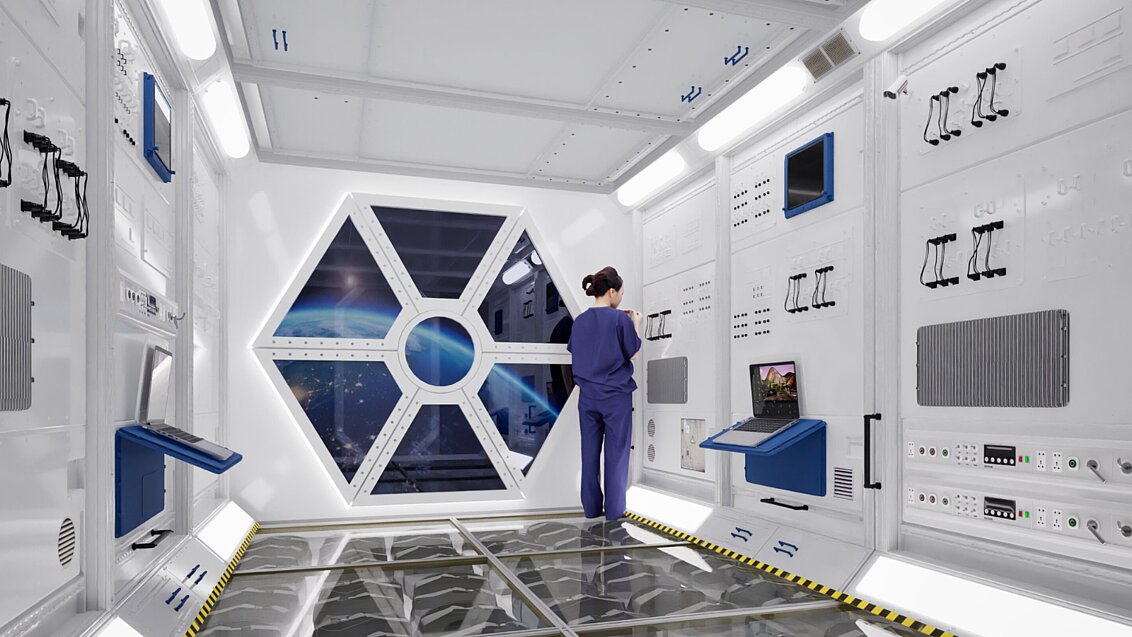
One of the most unique laboratories will be the Habitat for Analog Space Missions. The Habitat will be used both for training future astronauts and for testing technologies intended for use in space. AGH is the first university in Poland and one of the few in the world to boast such a facility.
The Habitat is designed to resemble the interior of the International Space Station. It is divided into several sections where experiment participants will sleep, conduct research, and live daily life. The space is organized into modules: laboratory, kitchen, hygiene, sleeping, and exercise.
Participants in the analog missions will function in conditions similar to those in space, performing tasks akin to those carried out by astronauts during real space missions. During these simulations, which can last a week or even longer, intensive research will be conducted on the effects of extreme "space-like" conditions on human physiology and behavior. Early warning systems and cybersecurity protocols will also be developed.
The Habitat provides a valuable testing ground for technological solutions before they are sent into orbit.
The Habitat is part of the Astrobiology and Space Biology laboratories. Other laboratories related to this innovative field include the Space Biology Laboratory and the Space Biomedical Engineering Laboratory.
In the Space Biology Laboratory, scientists will study the biological effects of spaceflight conditions on living organisms, including the role of gravity in amyloid formation and its impact on astronaut health. Research areas will include bioenergetics, gene expression, and the testing of bioactive substances for space travel, as well as studies on accelerated aging and adaptive evolutionary changes in space conditions. Understanding these processes will help develop preventive measures and life support systems for future space missions.
The Space Biomedical Engineering Laboratory will focus on research into aging processes both in space and on Earth, and on disease prevention. Using innovative technologies, scientists will develop solutions to combat chronic diseases, which will improve the health of not only astronauts but also society as a whole. Research areas will include organ-on-chip technology and the development of materials for health monitoring in space.
Another unique laboratory being developed at the Space Technology Centre is the so-called Dirty Chamber. This is a lunar surface simulator.
'We are living in an era of lunar exploration, of both manned and robotic missions to the Moon. We want to provide scientists with the conditions to study the behavior of both humans and devices that will work in typical lunar conditions—including dust storms and irradiated regolith,' explains Prof. Uhl.
The new Space Technology Centre building will also house laboratories such as the Satellite Telecommunications Laboratory, the Space Sensors Laboratory, the Materials Research Laboratory, and a Cleanroom Research Station. Additionally, student space science clubs and interdisciplinary project teams will have spaces to carry out their experiments and research.
The Space Sensors Laboratory will be dedicated to developing advanced nanomaterials for sensors used in space applications. Materials such as MXenes, graphene, and carbon nanotubes will be studied for their sensory capabilities in extreme space conditions. The laboratory will specialize in precise material application techniques, such as screen printing and printing.
In the Materials Research Laboratory, scientists will study the properties of various materials under conditions resembling those in space, including low and high temperatures, vacuum, and cosmic radiation. Materials will be tested for mechanical, chemical, magnetic, thermal, optical, and structural properties to assess their suitability for constructing space structures.
'We are currently working on four space missions. The LunarTech student club won a competition, thanks to which the device they developed will be sent to the Moon in 2027. The club's goal is to study the interaction of materials and coatings with regolith, the loose lunar rock.
We are also conducting two satellite missions. One of our satellites, Hype, developed by the SatLab student club, is integrated with a launcher and is waiting for its turn to be sent into low Earth orbit (LEO).
A second satellite is also being prepared, with its engineering model currently in development. It is a classic satellite equipped with a hyperspectral camera for Earth observation. The research results will be used in precision agriculture, environmental protection, and crisis management.
The final project is a manned mission. We are preparing the MXene in LEO experiment, which will be conducted on the International Space Station. It involves studying the properties of nanomaterials in space. We will also test the usefulness of these materials for measuring astronauts' vital signs,' summarizes Professor Uhl of the Space Technology Centre AGH.
In addition to conducting its own research, the Space Technology Centre also coordinates the international project UNIVERSEH—European Space University for Earth and Humanity on behalf of AGH. This is a consortium of seven partner universities from seven European countries. The strategy aims to increase student and faculty mobility and promote inter-university cooperation. The project enables the exchange of experiences and helps universities adapt their offerings to current market needs

