Events
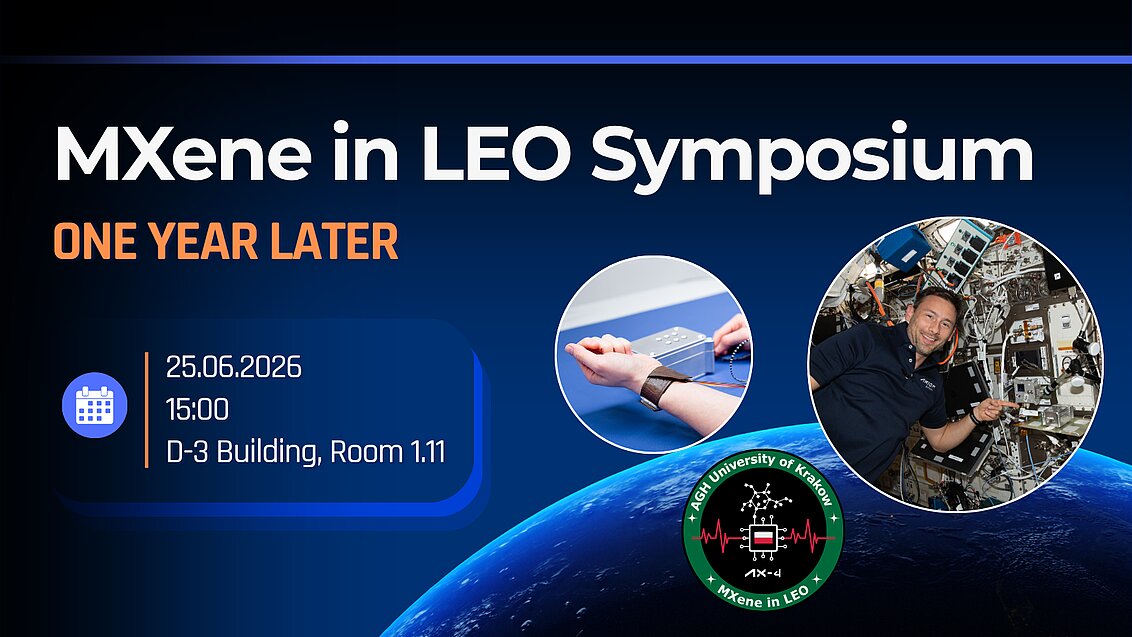
"MXene in LEO One Year Later" Symposium
- 25.06.2026
About MXene in LEO experiment
The MXene in LEO experiment, developed at AGH University of Krakow, aimed to investigate the properties of MXenes—advanced nanomaterials with potential applications in future space and medical technologies.
The experiment focused on two main objectives:
- studying the stability and behavior of MXenes in microgravity,
- testing wearable wristbands equipped with MXene-based sensors for monitoring wrist movements and pulse in space.
The wristbands were made from eco-friendly bacterial cellulose, a biocompatible material considered a sustainable alternative to petroleum-based plastics, with the potential for future in-orbit production aboard the International Space Station.
The in-orbit testing of the wearable device was conducted by astronaut Sławosz Uznański-Wiśniewski during the Ax-4 mission aboard the ISS. He wore the wristbands and performed a predefined sequence of wrist movements to evaluate the performance of the MXene-based sensors in a microgravity environment.
MXene in LEO – One Year Later
Although the Ax-4 mission concluded with the astronauts’ return to Earth, the story of the MXene in LEO experiment did not end there.
Over the past year, researchers have continued to analyze the collected data, conduct follow-up studies, and explore new applications inspired by the mission. The symposium offers an opportunity to reflect on this ongoing work and demonstrate how a space experiment can continue to drive scientific discovery and technological innovation long after leaving orbit.
By showcasing the progress made since the mission, the event highlights that MXene in LEO is an evolving research initiative rather than a completed project, with the potential to generate lasting impact both in space exploration and in life on Earth.
The event is held under the honorary patronage of the Polish Space Agency.
The Combined Effort Of People From Many Fields
A central theme of the symposium is the importance of interdisciplinary collaboration. The MXene in LEO project has brought together experts from a wide range of disciplines and professional backgrounds, demonstrating that ambitious space research relies on the combined efforts of many people working toward a common goal.
During the symposium, attendees will hear short presentations from contributors representing different fields and areas of expertise. Their talks will highlight both the scientific foundations of the experiment and the diverse follow-up activities that have continued during the year since the mission.
Together, these presentations will tell the story of a project that did not end with the Ax-4 mission but continues to generate new scientific knowledge, inspire innovation, and create meaningful impact beyond the space sector.
Join us
We warmly invite all members of the MXene in LEO community, as well as anyone interested in space technologies, and interdisciplinary research, to join us for this special occasion.
- Date: 25 June 2025
- Time: 3:00 PM CET
- Venue: Faculty of Space Technologies, AGH University of Krakow (Building D-3, Room 1.11 and online)
We look forward to celebrating one year of MXene in LEO with you!

