News
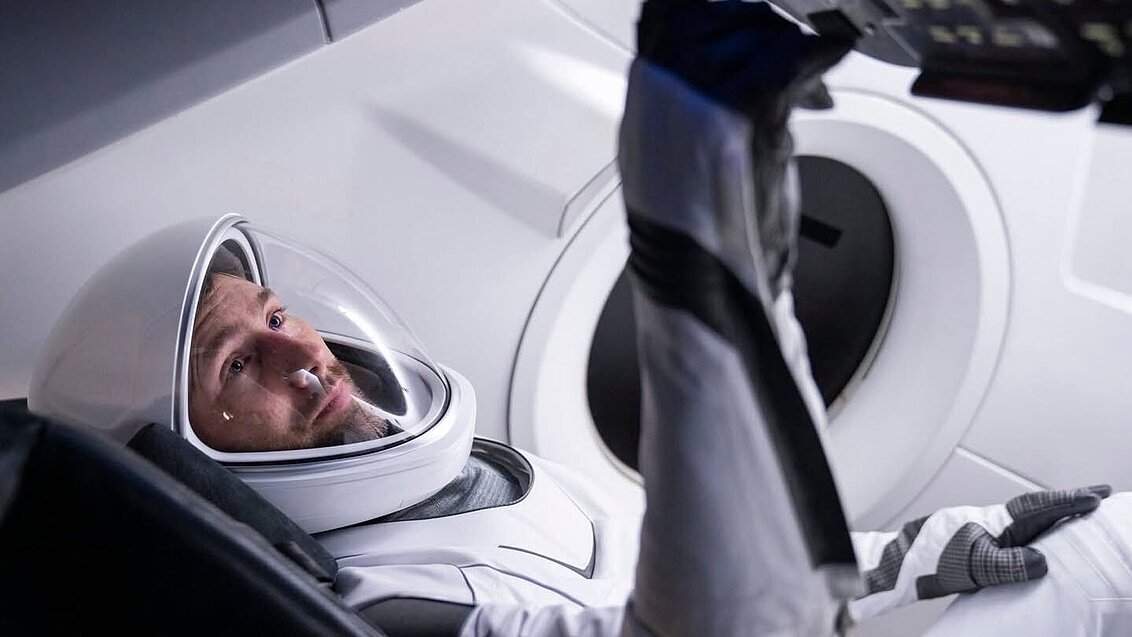
On 25 June 2025 at 08:31 CEST, a Falcon 9 launched the Ax-4 mission with Polish astronaut Dr. Sławosz Uznański-Wiśniewski and thirteen Polish experiments—among them AGH’s MXene in LEO!
Historic moment for Poland and AGH
25 June 2025 marks a historic day for Poland. At 08:31 CEST, a Falcon 9 rocket lifted off from a launch pad in the United States carrying the Ax-4 mission—aboard it, Polish ESA project astronaut Dr. Sławosz Uznański-Wiśniewski and thirteen Polish scientific experiments. Among them was the AGH University of Krakow's own project: MXene in LEO.
We watched the launch together at AGH’s Faculty of Space Technologies. Just before liftoff, the MXene in LEO team shared the behind-the-scenes story of their work. It was a special moment of unity—a shared celebration of Poland’s role in this space mission.
“Space for Everyone”: Words from Sławosz Uznański-Wiśniewski
“Dear Poles, today we take a giant step toward Poland’s technological future: Poland built on science and knowledge. May this mission mark the beginning of an era in which our courage and perseverance shape a modern Poland for us and for future generations. Space has always united people. I carry with me from Earth a piece of each of you: your strength, your hope, your trust. I am not alone in space, I represent all of us. From the bottom of my heart, thank you for your trust. Space for everyone.”
— Dr. Sławosz Uznański-Wiśniewski, aboard the Dragon capsule
This motto, "Space for everyone", has guided us since the founding of our faculty!
When we created the Faculty of Space Technologies, our goal was clear: to show that space is within everyone’s reach—not just for the privileged, the wealthiest, or the most gifted. You can study Space Technologies right here in Poland at AGH. Moreover, “space is for everyone.” Engineers, yes—but also biologists, chemists, geologists, and even those in the humanities. That’s why we launched the "Zero semester" program for bachelor’s-degree holders from any field, not just enigneers. Our mission is to prove that space is closer than you think: although it may seem distant, it’s really just within arm’s reach—if you dare to reach for it.
The MXene in LEO Experiment
MXenes are ultrathin nanomaterials composed of titanium carbide layers—no thicker than 100 nanometers. They exhibit extraordinary sensitivity and potential for use in biometric sensors. The AGH experiment investigates how these advanced materials behave in microgravity aboard the ISS.
At the heart of the experiment are special wristbands made from bacterial cellulose, to which MXene sensors are attached. These sensors detect even the tiniest muscular movements, allowing them to monitor an astronaut’s heart rate and motion. Remarkably, the bacterial cellulose biomaterial requires no complex equipment to produce—it could even be manufactured in space.
Testing in space and on Earth
During his two-week stay on the ISS, Sławosz Uznański-Wiśniewski will test six wristbands by performing predetermined wrist-movement sequences. Simultaneously, an identical set of tests will be conducted in AGH’s laboratories, enabling direct comparison of orbital and terrestrial data.
Design Collaboration with the Faculty of Industrial Design from the Academy of Fine Arts in Kraków
The wristband needed not only to work flawlessly but also to be managed with one hand—a formidable challenge in microgravity. That’s why we partnered with the Faculty of Industrial Design at the Academy of Fine Arts in Kraków (ASP). Under the guidance of Prof. Michał Kracik, students designed an ergonomic form perfectly suited to life aboard the ISS. This fusion of science and design was a perfect collaboration which resulted in a functional solution for an extreme environment.
From space back to Earth
Although the experiment is conducted in orbit, its results have the potential to transform healthcare here on Earth.
The MXene in LEO wristband may one day be used in telemedicine and remote health monitoring, serving as a non-invasive tool for physical therapy, remote rehabilitation, and care for patients with chronic conditions.
Górnośląskie Centrum Medyczne will carry out the first clinical validation studies. There, patients—including those with cardiac arrhythmias—will test the wristband under real hospital conditions. The data collected will complement the findings from microgravity experiments, helping to assess the device’s effectiveness in clinical practice.
This is a prime example of how solutions developed for space exploration can genuinely benefit life on Earth.

